




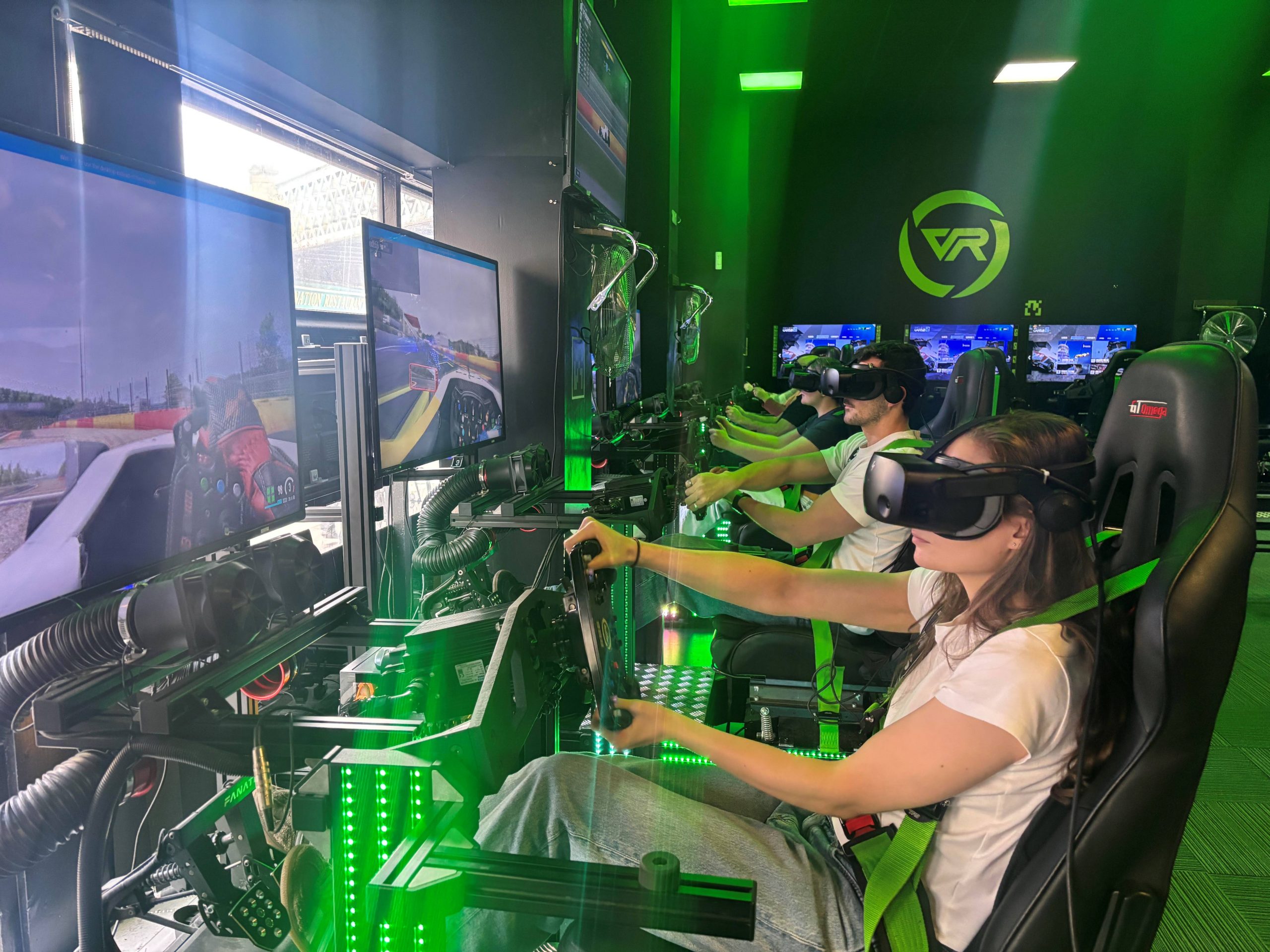
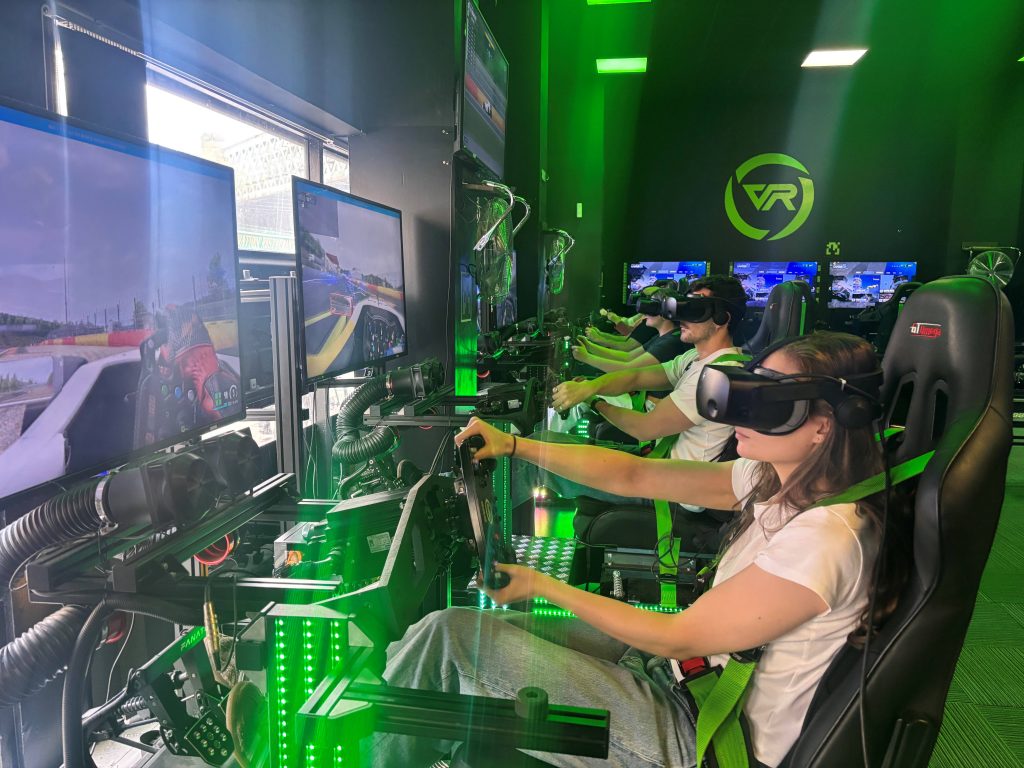
The first corner arrives faster than you expect. Your seat leans into the braking zone, the wind picks up as the speed climbs, and someone beside you has already chosen the optimistic line. That is VR racing at its best: not a quick turn on an arcade machine, but a proper shared race where every lap gives you another chance to fight back.
For motorsport fans, gamers, families and groups looking for more than the usual night out, it delivers the rush of performance driving without needing a racing licence, waterproofs or a repair bill. Pick a car, choose a circuit and get on the grid. The only thing left to settle is who reaches the chequered flag first.
What Makes VR Racing Feel So Real?
A screen alone cannot make you feel as though you are flying down a straight at 200mph. The difference comes when your eyes, hands and body receive the same story at once. A VR headset puts the circuit around you, from the apex kerbs to the mirrors. A steering wheel and pedals put the car under your control. Then the simulator seat moves, the haptic feedback responds and wind effects build as the speed rises.
That combination makes braking feel urgent and cornering feel physical. You can sense the car pitch forward under heavy braking, lean through a fast bend and react when the rear starts to step out. It is controlled motion rather than a fairground ride, designed to support what is happening on track.
The detail matters because racing is about judgement. You are looking for a braking marker, balancing the throttle and deciding whether there is room for an overtake. When the car feels connected to your inputs, a good lap becomes genuinely satisfying. Miss the apex, and you will know about it.
You Drive, Rather Than Watch
The best virtual races do not put you on rails. You choose whether to attack the corner or play the long game. You can brake late, defend the inside line or risk a wider entry for a better exit. Beginners can learn the circuit lap by lap, while experienced drivers can chase consistency, tyre-saving racecraft and the fastest possible time.
There is also a big difference between racing alone and lining up against people you know. A personal best is pleasing. Holding off your mate for three laps while they fill your mirrors is something everyone remembers on the way home.
More Cars, More Tracks, No Waiting for Repairs
Traditional go-karting has a clear appeal, but it also has limits. You are driving one type of kart on one circuit, in whatever weather has turned up that day. In virtual motorsport, you can switch from a nimble kart to a road car, a supercar, an off-road machine or a Formula 1 car without leaving the venue.
The track choice changes the challenge just as much as the vehicle. A tight kart circuit rewards quick reactions and bold overtakes. A real-world Grand Prix circuit gives you high-speed corners, long braking zones and room for race strategy. Street circuits punish small mistakes, while off-road routes ask you to keep the car composed when the surface is anything but smooth.
That variety is ideal for groups with mixed experience. One person may want the precision of a single-seater, while another simply wants to slide a fast road car through a dramatic circuit. You can build a session around the group rather than forcing everyone into the same kart and the same lap.
Better still, there is no queue while somebody’s vehicle is repaired after a heavy bump. Virtual crashes can be spectacular, but nobody goes home with bruised ribs and nothing needs to be taken out of service. Reset, laugh about it, and rejoin the race.
Fair Competition Without the Karting Frustrations
In a close race, people want to know that the result came down to driving. VR racing gives every driver access to the same car performance when the event calls for it. That means the contest is about braking points, clean exits and how well you handle pressure, not whether you drew the kart that feels a little quicker.
It also removes some of the frustrations that can take the shine off conventional karting. Rain does not cancel the fun. Cold weather does not make a birthday party miserable. There are no exhaust fumes, no helmet hair from a damp outdoor session and no concern about a minor contact turning into a painful one.
That does not make the racing gentle. First corners can still be chaotic, a last-lap lunge can still go wrong, and one overconfident move can still cost you places. The difference is that the competition stays intense while the environment stays controlled and safe.
Why It Works for Groups of Every Kind
A great group activity needs to give everyone a role. In a VR race, the quiet person can become unexpectedly quick, the self-proclaimed expert gets a lap time to prove, and complete beginners have a clear goal: make the next lap cleaner than the last one. There is always a story developing on the timing screen.
For a family day out, the appeal is accessible excitement. Younger racers can experience the thrill of motorsport with guidance and supervision, while adults get a challenge that does not feel childish. For birthdays, stag and hen celebrations, the format naturally creates banter without leaving anyone sat on the sidelines for long.
Corporate groups often find the same competitive energy useful. A race gets people talking quickly because it creates shared moments: a brave overtake, an accidental spin, a comeback from the back of the grid. Unlike an activity based purely on strength or fitness, a well-organised simulator event gives different personalities a real chance to shine.
At VR Simulators in Glasgow, that is the point of putting groups on the same virtual grid. The technology brings the speed and physical sensation, but the people around you turn it into an event.
Choose the Right Race for Your Group
There is no single best way to race. A short session is brilliant for first-timers who want a powerful taste of the experience. A longer format gives drivers time to learn the car and circuit, so the final race becomes much closer. If your group has competitive regulars, a Grand Prix-style event with practice, qualifying and races creates a proper motorsport atmosphere. Alternatively unlimited racing packages gives you a buffet style event with three hours to sample lots of different cars and tracks.
Car choice deserves thought too. Fast machinery is exciting, but it can be demanding for new drivers. Starting with something predictable lets everyone understand the controls and find their confidence. Once the laps are clean, step up to the supercars or single-seaters and see who can keep their nerve under braking.
If someone is unsure about VR, reassurance helps. Staff can explain the controls, help them get comfortable in the headset and choose a suitable car and circuit. Most people settle into the experience quickly, especially when they focus on driving rather than trying to take in every visual detail at once. Anyone prone to motion sickness should mention it before racing, take breaks if needed and begin with a shorter session.
The Race Starts Before the Lights Go Out
The quickest driver does not always win the day. The best group races are the ones where everyone has a moment: a surprise pole position, a dramatic recovery, a clean pass that gets replayed in conversation afterwards. That is why the right format, car and circuit matter as much as outright speed.
Gather your rivals, pick a track that suits the mood and give every driver a chance to find their line. By the time the lights go out, you will not be looking for something to do. You will be racing for bragging rights
